Gotabaya Rajapakse, President of Sri Lanka (elected on Nov 16, 2019)
 Lieutenant Colonel Nandasena Gotabaya Rajapaksa, RWP, RSP, psc, GR (born 20 June 1949) is a Sri Lankan politician, technocrat, military officer, and the President-elect of Sri Lanka, having gained a majority in the 2019 Presidential election, which he contested from the Sri Lanka Podujana Peramuna, which is lead by his brother, former President Mahinda Rajapaksa. He served as Secretary to the Ministry of Defence and Urban Development from 2005 to 2015 under the administration of his brother, leading the Sri Lankan Armed Forces to the military defeat of the Tamil tigers, ending the Sri Lankan Civil War.
Born to a prominent political family from the south of Sri Lanka, Rajapaksa was educated at Ananda College, Colombo and joined the Ceylon Army in April 1971. Following basic training at Army Training Centre, Diyatalawa, he was commissioned as singles officer and later transferred to an infantry regiment. He saw active service in the early stages of the Sri Lankan Civil War with the elite Gajaba Regiment, taking part in several major offensives such as the Vadamarachi Operation, Operation Strike Hard and Operation Thrividha Balaya, as well as counter insurgency operations during the 1987–1989 JVP insurrection. He took early retirement from the army and moved in to the field of information technology, before immigrating to the United States. He return in 2005, to assist his brother in his presidential campaign and was appointed Defense Secretary in his brother’s administration. During his tenure the Sri Lankan Armed Forces successfully concluded the Sri Lankan Civil War defeating the Tamil tigers and killing its leader Velupillai Prabhakaran. He was a target of an assassination attempt in December 2006 by a Tamil Tiger suicide bomber. Following the war, Rajapaksa initiated many urban development projects. He step-down following the defeat of his brother in the 2015 Presidential election. In 2018, he emerged as a possible candidate for the 2019 Presidential election, which he successfully contested on a pro-nationalistic, economic development and national security platform.
Source: https://en.wikipedia.org/wiki/Gotabaya_Rajapaksa
Maithripala Sirisena, Former President of Sri Lanka (since Jan 9, 2015)
 Pallewatte Gamaralalage Maithripala Yapa Sirisena (pronounced [pallewat̪t̪ə ɡaməraːləlaːɡeː majt̪ɾiːpaːlə jaːpaː siɾiseːnə]; known as Maithripala Sirisena or also referred to as “Maithri”; Sinhalese: මෛත්රිපාල සිරිසේන; Tamil: மைத்திரிபால சிறிசேன; born 3 September 1951) is a Sri Lankan politician who has been President of Sri Lanka since 2015. Although born in the Western Province, Sirisena hails from the North Central Province of the county, the first president from that province. He is a farmer and agriculturist and does not belong to any of the Sri Lankan political elite.
Sirisena joined mainstream politics in 1989 as a member of the Parliament of Sri Lanka and has held several ministries since 1994. He was the general-secretary of the Sri Lanka Freedom Party and was Minister of Health until November 2014 when he announced his candidacy for the 2015 presidential election as the opposition coalition’s “common candidate”. His victory in the election is generally viewed as a surprise, coming to office through the votes won from the alternative Sinhala-majority rural constituency and the Tamil and Muslim minority groups that have been alienated by the Rajapaksa government on post-war reconciliation and growing sectarian violence. Their votes were more anti-Rajapaksa than pro-Sirisena. Maithripala Sirisena has pledged to implement a 100-day reform program where he has promised to rebalance the executive branch within 100 days of being elected, by reinforcing Sri Lanka’s judiciary and parliament, to fight corruption and to investigate allegations of war crimes from 2009, repeal the controversial eighteenth amendment, re-instate the seventeenth amendment and appoint UNP leader Ranil Wickremasinghe as Prime Minister.
Sirisena was sworn in as the sixth executive president before Supreme Court judge K. Sripavan in Independence Square, Colombo at 6.20pm on 9 January 2015. Immediately afterwards he appointed Ranil Wickremesinghe as the new Prime Minister. After being sworn in Sirsena stated that he would only serve one term.
Although legally entitled to use the style His Excellency as the President of Sri Lanka, he requested the media and the people of Sri Lanka, avoid using the style and also to avoid using the word First Lady for his wife, and requested only to use “President’s wife”. On April 28, 2015, Sirisena voluntarily transferred significant presidential powers to parliament.
Sirisena is married to Jayanthi Pushpa Kumari, they have two daughters (Chathurika and Dharani) and a son (Daham). He is a teetotaler, a practising Buddhist and has a reputation for honesty and hard work.
President Sirisena’s youngest brother, Priyantha Sirisena, died on 28 March 2015 after an axe attack two days earlier in his hometown of Polonnaruwa, 215 kilometres north-east of the capital Colombo. Priyantha was immediately transferred to hospital in a critical condition, where he died from severe head injuries. At that time, President Sirisena was in China on a state visit.
Source: https://en.wikipedia.org/wiki/Maithripala_Sirisena
Mahinda Rajapaksa, Former President of Sri Lanka
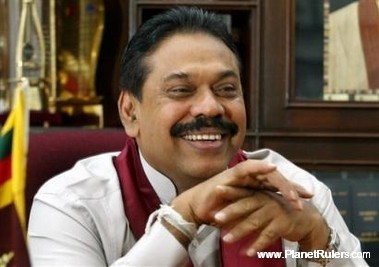
President Mahinda Rajapaksa hails from a well known political family. His uncle D.M. Rajapaksa known as the Lion of Ruhuna, a State Councilor for Hambantota from the 1930s started wearing the earthy brown shawl (also worn by President Mahinda Rajapaksa) to represent the kurakkan (a type of local maize) cultivated by the people of his area, whose cause he championed right throughout his life.President Mahinda Rajapaksa’s father D.A. Rajapaksa was a well-known public figure and many have remarked on his integrity, courage and perseverance with which he carried out his duties. He succeeded his brother in the Hambantota district in the second State Council of Ceylon.
President Rajapaksa is married to Shiranthi Rajapaksa and has three sons.
-Education/ Early life
Born in Weeraketiya in the deep south, November 18, 1945, Rajapaksa schooled at Richmond College, Galle, later shifting to Nalanda College and Thurstan College Colombo. In 1974 he passed out as an Attorney-at-Law from the Colombo Law College and took his place at the bar, with a special interest in human rights.
Throughout his parliamentary career, except for the period from 1994-2001 when he was a minister, he continued his law practice in Tangalle, to whose development Rajapaksa has a great commitment.
Loyalty to principle and party has been the hallmark of Rajapaksa’s political philosophy. Loyalty was, what his father, was especially remembered for. When the SLFP’s founder S.W.R.D. Bandaranaike, left the UNP to form the SLFP in 1951, all his promised allies had abandoned him, but for D.A. Rajapaksa, who crossed over with him.
– Early political life
Mahinda Rajapaksa was first elected to Parliament as an SLFP member, from the Beliatta seat in 1970. At just 24 years of age at the time, he was the youngest member of the House. His father, D.A. Rajapaksa represented the same seat from 1947 to 1965.
He lost his parliamentary seat in the landslide victory of the UNP in 1977. In 1989 he was re-elected to Parliament to represent Hambantota District under Proportional Representation.
From the start of his career, Rajapaksa adopted a centre-left political stance, identifying himself with labour rights and becoming a champion of human rights. He was a leading member of the Parliamentarians for Human Rights.
He came into prominence as a leader, together with Dr. Manorani Saravanamuttu, of the Mothers Front, which organized the mothers of the “disappeared” in the white terror of 1988-90. The Visva Bharati University of Calcutta in India conferred on him the title Professor Emeritus for his record on human rights.
He has been the President of the Sri Lankan Committee for Solidarity with Palestine for the past 25 years and has always maintained a close interest in finding a peaceful solution to the Middle East problem within the framework of a sovereign Palestinian state.
Rajapaksa was Minister for Labour and for Fisheries in President Kumaratunga’s Cabinet from 1994 to 2001. As the Minister of Fisheries he started a University for Oceanography and established a Coastal Guard Unit.
As Minister of Labour he drafted and presented the Worker’s Charter, the first in Sri Lanka, which was not implemented by the Kumaratunga administration.
He also held the Portfolio of the Ports and Shipping in addition to Fisheries, for three months. During this period he initiated work for the construction of a new harbour at Hambantota.
In March 2002 Rajapaksa was elected Leader of the Opposition.
After the elections of April 2004 in which the United People’s Freedom Alliance was victorious, President Chandrika Kumaratunga appointed Mahinda Rajapaksa as the country’s 13th Prime Minister on April 6, 2004.
For the November 2005 Presidential election Mahinda Rajapaksa was chosen as the Presidential Candidate of the Sri Lanka Freedom Party for the election held on 17 November 2005, when his candidature was approved by 25 political parties and people’s movements.
Mahinda Rajapaksa was sworn in as the fifth Executive President of the Socialist Republic of Sri Lanka on the 19th of November 2005, after being elected President with a majority that endorsed his manifesto in a closely contested and peaceful election.