Giorgia Meloni, Prime Minister of Italy (since Oct 22, 2022)
 Giorgia Meloni (born 15 January 1977) is an Italian politician who has been serving as the prime minister of Italy since 22 October 2022, the first woman to hold this position. A member of the Chamber of Deputies since 2006, she has led the Brothers of Italy (FdI) political party since 2014, and she has been the president of the European Conservatives and Reformists Party since 2020.
In 1992, Meloni joined the Youth Front, the youth wing of the Italian Social Movement (MSI), a neo-fascist political party founded in 1946 by former followers of Italian fascist dictator Benito Mussolini. She later became the national leader of Student Action, the student movement of the National Alliance (AN), a post-fascist party that became the MSI’s legal successor in 1995 and moved towards national conservatism. She was a councillor of the Province of Rome from 1998 to 2002, after which she became the president of Youth Action, the youth wing of AN. In 2008, she was appointed Italian Minister of Youth in the Berlusconi IV Cabinet, a role which she held until 2011. In 2012, she co-founded FdI, a legal successor to AN, and became its president in 2014. She unsuccessfully took part in the 2014 European Parliament election and the 2016 Rome municipal election. After the 2018 Italian general election, she led FdI in opposition during the entire 18th Italian legislature. FdI grew its popularity in opinion polls, particularly during the management of the COVID-19 pandemic in Italy by the Draghi Cabinet, a national unity government to which FdI was the only opposition party. Following the fall of the Draghi government, FdI won the 2022 Italian general election.
A right-wing populist and nationalist, her political positions have been described as far right, which she rejects. She describes herself as a Catholic Christian and a conservative, and she claims to defend “God, fatherland, and family”. She is opposed to abortion, euthanasia, same-sex marriage, and LGBT parenting, saying that nuclear families are exclusively headed by male–female pairs. Her discourse includes criticism of globalism and femonationalist rhetoric. Opposed to the reception of non-Christian migrants and multiculturalism, Meloni supports a naval blockade to halt immigration, and she has been accused of xenophobia and Islamophobia; she has blamed neo-colonialism as a cause behind the European migrant crisis. A supporter of NATO, she maintains Eurosceptic views regarding the European Union, which she describes as Eurorealist, and was in favour of better relations with Russia before the 2022 Russian invasion of Ukraine, which she condemned, pledging to keep sending arms to Ukraine.
Meloni has expressed controversial views, such as praising Mussolini when she was 19. In 2020, she praised Giorgio Almirante, a civil minister in Mussolini’s Italian Social Republic who produced racist propaganda and co-founded the MSI. Nevertheless, Meloni has said that she and her party condemn both the suppression of democracy and the introduction of the Italian racial laws by the fascist regime.
Meloni has a daughter, Ginevra, with her partner Andrea Giambruno, a journalist who works for Silvio Berlusconi’s Mediaset TV channel. She has said that she is a Catholic Christian and has used her religious identity in part to help build her national brand. In a 2019 speech to a rally in Rome, she said: “I am Giorgia. I’m a woman, I’m a mother, I’m Italian, I’m Christian.” In September 2022, she reportedly continued to embrace the old Italian fascist slogan “God, fatherland and family”. She has said she resents being linked to Italy’s fascist past.
Meloni is an avowed fan of fantasy, particularly J. R. R. Tolkien’s The Lord of the Rings. As a youth activist with the Italian Social Movement (MSI), she attended the Camp Hobbit festival and sang along with the far-right folk band Compagnia dell’Anello [it], named after The Fellowship of the Ring. Later, she named her political conference Atreju, after the hero of the novel The Neverending Story. Meloni told The New York Times: “I think that Tolkien could say better than we can what conservatives believe in.”Apart from Tolkien, she is fond of British conservative philosopher Roger Scruton and has said: “If I were British I would be a Tory.”
Source: https://en.wikipedia.org/wiki/Giorgia_Meloni
Mario Draghi, Former Prime Minister of Italy (since Feb 13, 2021)
 Mario Draghi OMRI (born 3 September 1947) is an Italian economist, banker, academic and civil servant who has been Prime Minister of Italy since 13 February 2021. He previously served as President of the European Central Bank (ECB) from 2011 until 2019. Draghi was also Chair of the Financial Stability Board from 2009 to 2011 and Governor of the Bank of Italy from 2006 to 2011.
After a lengthy career as an academic economist in Italy, Draghi worked for the World Bank in Washington, D.C., throughout the 1980s, and in 1991 returned to Rome to become Director General of the Italian Treasury. He left that role after a decade to join Goldman Sachs, where he remained until his appointment as Governor of the Bank of Italy in 2006. His tenure as Governor coincided with the 2008 Great Recession, and in the midst of this he was selected to become the first Chair of the Financial Stability Board, the global standard-setter that replaced the Financial Stability Forum.
He left those roles after his nomination by the European Council in 2011 to serve as President of the ECB. He presided over the institution during the Eurozone crisis, becoming famous throughout Europe for saying that he would be prepared to do “whatever it takes” to prevent the euro from failing. In 2014, Draghi was listed by Forbes magazine as the eighth-most powerful person in the world. In 2015, Fortune magazine ranked him as the world’s “second greatest leader”. He is also the only Italian to be listed three times in the Time 100 annual listicle. In 2021, Politico Europe ranked him as the most powerful person in Europe. In 2019, Paul Krugman described him as “the greatest central banker of modern times.” Moreover, thanks to his monetary policies, he is widely considered the “saviour of the euro” during the European debt crisis. He has been nicknamed Super Mario by some media, a nickname that was popularised during his time as President of the ECB, when he was credited by numerous sources as having played a key role in combatting the Eurozone crisis.
After Draghi’s term as ECB President ended in 2019, he initially returned to private life. On 3 February 2021, in the midst of the COVID-19 pandemic, Draghi was invited by Italian President Sergio Mattarella to form a government of national unity, following the resignation of Giuseppe Conte. After successful negotiations with parties including the League, the Five Star Movement, the Democratic Party and Forza Italia, Draghi was sworn in as Prime Minister on 13 February, pledging to oversee effective implementation of COVID-19 economic stimulus. His time as Prime Minister has seen him rated highly in public opinion polls, and at the end of his first year in office, the Economist magazine named Italy as its ‘Country of the Year’, singling out Draghi’s leadership as central to its decision.
In 1973, Mario Draghi married Maria Serenella Cappello, of noble origins and descendant of Bianca Cappello, and an expert in English literature, with whom he has two children: Federica, who worked as investment director of Genextra Spa and board member of Italian Angels for Biotechis, and Giacomo, a finance analyst, who worked as an interest-rate derivative trader at investment bank Morgan Stanley until 2017, and is now at the LMR Partners hedge fund.
Draghi is a Roman Catholic of Jesuit education and is devoted to St. Ignatius of Loyola. Draghi has homes in Rome’s Parioli district and in Città della Pieve in Umbria. He is a supporter of A.S. Roma, one of the football teams of his hometown, and a great fan of basketball.
Source: https://en.wikipedia.org/wiki/Mario_Draghi
Giuseppe Conte, 58th Prime Minister of Italy (since Jun 1, 2018; resigned on Jan 25, 2021)
 A professor of private law, Conte was first proposed on 21 May 2018 for the role of Prime Minister as the head of a coalition government between the Five Star Movement and the League, but he relinquished his role when Paolo Savona, who was picked for Minister of Economy and Finance, was vetoed by President Sergio Mattarella. On 31 May, the two parties reached an agreement, proposing Giovanni Tria as Minister of Economy and Finances, and Conte was called to take the oath of office on the following day.
Conte’s cabinet is considered by many newspapers such as The New York Times and la Repubblica as the first populist government in Western Europe. Moreover, he was the first person to assume the premiership without prior government or administrative service since Silvio Berlusconi in 1994 and the first Prime Minister from Southern Italy since the Christian Democrat Ciriaco De Mita in 1989.
Conte was born on 8 August 1964 into a middle class family at Volturara Appula, near Foggia. His father Nicola was a public employee in the local municipality while his mother Lillina Roberti was an elementary school teacher.
After his family moved to San Giovanni Rotondo, Conte attended the Classical Lyceum “Pietro Giannone” in nearby San Marco in Lamis and then studied Law at the La Sapienza University of Rome, where he graduated in 1988 with distinction. For short terms, Conte studied abroad. In 1992, he moved to the United States to study at Yale Law School and Duquesne University and at the International Culture Institute in Vienna in 1993. He later researched or lectured at Sorbonne University in 2000, Girton College, Cambridge in 2001 and New York University in 2008.
He started his academic career during the 1990s, when he taught at Roma Tre University, at LUMSA University of Rome, at the University of Malta and at the University of Sassari. Conte is currently professor of private law at the University of Florence and at LUISS of Rome. He sits on the board of trustees of John Cabot University in Rome.
On 18 September 2013, he was elected by the Chamber of Deputies as a member of the Bureau of Administrative Justice, the self-governing body of administrative magistrates.
Paolo Gentiloni, Former Prime Minister of Italy (since Dec 12, 2016)
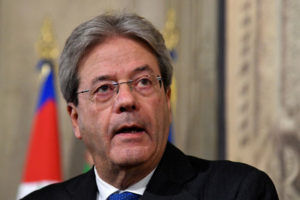 A descendant of Count Gentiloni Silveri, he is related to the Italian politician Vincenzo Ottorino Gentiloni, leader of the conservative Catholic Electoral Union and a key ally of the long-time Prime Minister Giovanni Giolitti. He has the title of Nobile of Filottrano, Nobile of Cingoli and Nobile of Macerata.
Born in Rome, he attended the Classical Lyceum Torquato Tasso in the city and graduated in political sciences at the La Sapienza University; Gentiloni is a professional journalist.
On 10 January 2017, after an official trip in Paris to met President François Hollande, Gentiloni suffered an obstructed coronary artery and he was subjected to an emergency angioplasty. On the following day Gentiloni tweeted that he felt well and would be back at work soon. On the same day he also received the wishes from President Sergio Mattarella, former Prime Ministers Matteo Renzi and Silvio Berlusconi and Canadian Prime Minister Justin Trudeau
Source: https://en.wikipedia.org/wiki/Paolo_Gentiloni
Matteo Renzi, Former Prime Minister of Italy (since Feb 22, 2014)
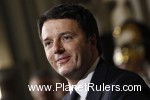 Matteo Renzi (Italian pronunciation: [matˈtɛo ˈrɛntsi]; born 11 January 1975) is an Italian politician who has been Prime Minister of Italy since 22 February 2014 and the Secretary of the Democratic Party since 15 December 2013. He was previously the President of Florence Province from 2004 to 2009 and the Mayor of Florence from 2009 to 2014.
At the age of 39, Renzi overtook Benito Mussolini’s record as the youngest person to become Prime Minister of Italy since unification in 1861. He is also the first to be elected Prime Minister as a Mayor. Renzi has been described as the de facto leader of the Party of European Socialists, in opposition to Angela Merkel’s People’s Party; the two leaders are together referred to as Merkenzi. Moreover he was ranked as the third most influential under 40 person in the world, by the American magazine Fortune and in the Top 100 Global Thinkers by Foreign Policy.
In 1999 Renzi married Agnese Landini, a teacher, with whom he has two sons, Francesco and Emanuele, and a daughter, Ester. Renzi is a regular Mass-goer and was active in a Catholic branch of the Scouts.
Renzi is an avid football fan, and supports Fiorentina, the team of his hometown Florence.[187] Renzi has also stated that he is a fan of the American TV series House of Cards; some observers noted similarities between the rise to power of the character Francis Underwood, played by Kevin Spacey, and the manner in which Renzi replaced Enrico Letta as Prime Minister.
At the 2014 local elections, his sister Benedetta was elected a municipal councillor for the Democratic Party in Castenaso, a small comune near Bologna. Renzi’s father, Tiziano, had previously been a municipal councillor in Rignano sull’Arno, near Florence, for the Christian Democracy.
Source: https://en.wikipedia.org/wiki/Matteo_Renzi

Enrico Letta, Former Prime Minister of Italy (since Apr 24, 2013)
The Prime Minister of Italy, officially the President of the Council of Ministers of the Italian Republic (Italian: Presidente del Consiglio dei Ministri) is the head of government of the Italian Republic.
While the office is similar to those in most other parliamentary systems, the Italian prime minister has less authority than some of his counterparts. The prime minister is not authorized to request the dissolution of the Parliament of Italy or to dismiss ministers, and must receive a vote of approval from the Council of Ministers—which holds effective executive power—to execute most political activities.
The office was established by Articles 92 through to 96 of the current Constitution of Italy. The prime minister is appointed by the President of the Republic after each general election. Commonly referred to in Italy as premier, the right title of the office holder is Presidente del Consiglio dei Ministri, or just Presidente del Consiglio. The formal Italian order of precedence lists the office as being ceremonially the fourth most important Italian state office.
Full bio: http://www.governo.it/Presidente/Biografia/biografia_it.html
Mario Monti, Former Prime Minister of Italy (since Nov 16, 2011)
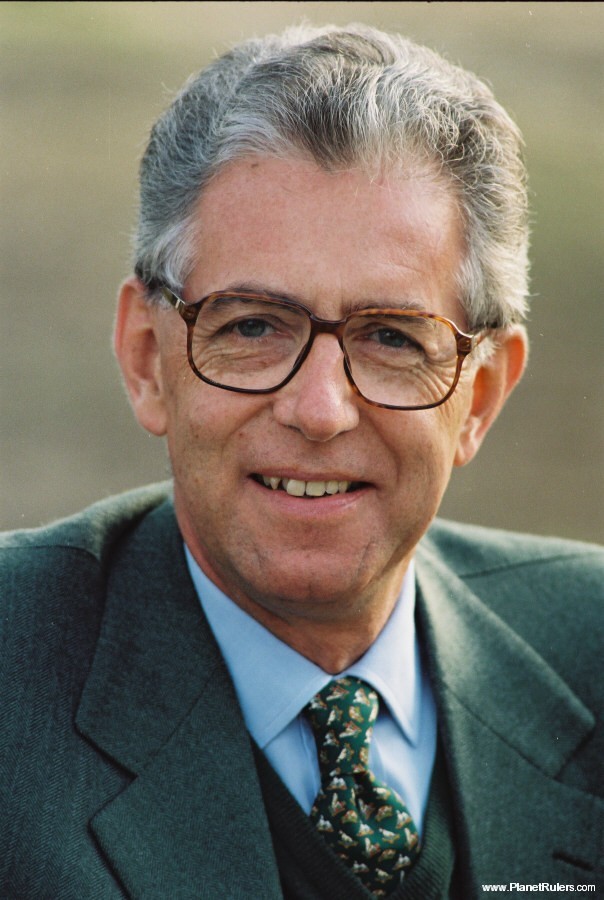 Mario Monti (born 19 March 1943) is an Italian economist and academic who is Prime Minister of Italy, as well as Minister of Economy and Finance, since November 2011. Monti served as a European Commissioner from 1995 to 2004, with responsibility for the Internal Market, Services, Customs and Taxation from 1995 to 1999 and then for Competition from 1999 to 2004. He has also been Rector and President of Bocconi University. Monti was appointed a Senator for Life in the Italian Senate on 9 November 2011, and three days later was invited by President Giorgio Napolitano to form a new technocratic government in Italy following the resignation of Silvio Berlusconi.
Mario Monti was born in Varese on 19 March 1943. His father hailed from Varese (though he spent much of his life in Argentina after emigrating during World War II), and his mother was born in Piacenza. Mario Monti holds a degree in economics and management from Bocconi University, Milan. He completed graduate studies at Yale University, where he studied under James Tobin, the Nobel prize-winning economist.
He taught economics at the University of Turin from 1970 to 1985 before moving to Bocconi University, where he was its Rector from 1999 to 2001, and has been its President since 1994. He was also the President of SUERF (The European Money and Finance Forum) from 1982 to 1985. His research has helped to create the ‘Klein-Monti model’, aimed at describing the behaviour of banks operating under monopoly circumstances.
Monti is a member of the Presiderium of the Friends of Europe, a leading European think tank, and was the first chairman of Bruegel, a European think tank founded in 2005. He is the European Chairman of the Trilateral Commission, a think tank founded in 1973 by David Rockefeller. He is also a leading member of the exclusive Bilderberg Group.
Monti has been an international advisor to Goldman Sachs and The Coca-Cola Company.
On 9 November 2011, Monti was appointed a Lifetime Senator by Italian President Giorgio Napolitano. Mario Monti was seen as a favorite to replace Silvio Berlusconi to lead a new unity government in Italy in order to implement reforms and austerity measures. On 12 November 2011, following Berlusconi’s resignation, Napolitano invited Monti to form a new government. Monti accepted the offer, and held talks with the leaders of Italy’s political parties, saying that he wanted to form a government that would remain in office until the next scheduled elections in 2013. On 16 November 2011, Monti unveiled a technocratic cabinet, and was officially sworn in as Prime Minister of Italy. He also appointed himself as Minister of Economy and Finance.
Mario Monti is married, and has two children.
Known for his reserved character, Monti acknowledges not being especially sociable, explaining that his youth was given over to hard study, alongside spare time activities such as cycling and keeping up with world affairs by tuning in to foreign short wave radio stations.
Silvio Berlusconi, Former Prime Minister of Italy (resigned on Nov 12, 2011)
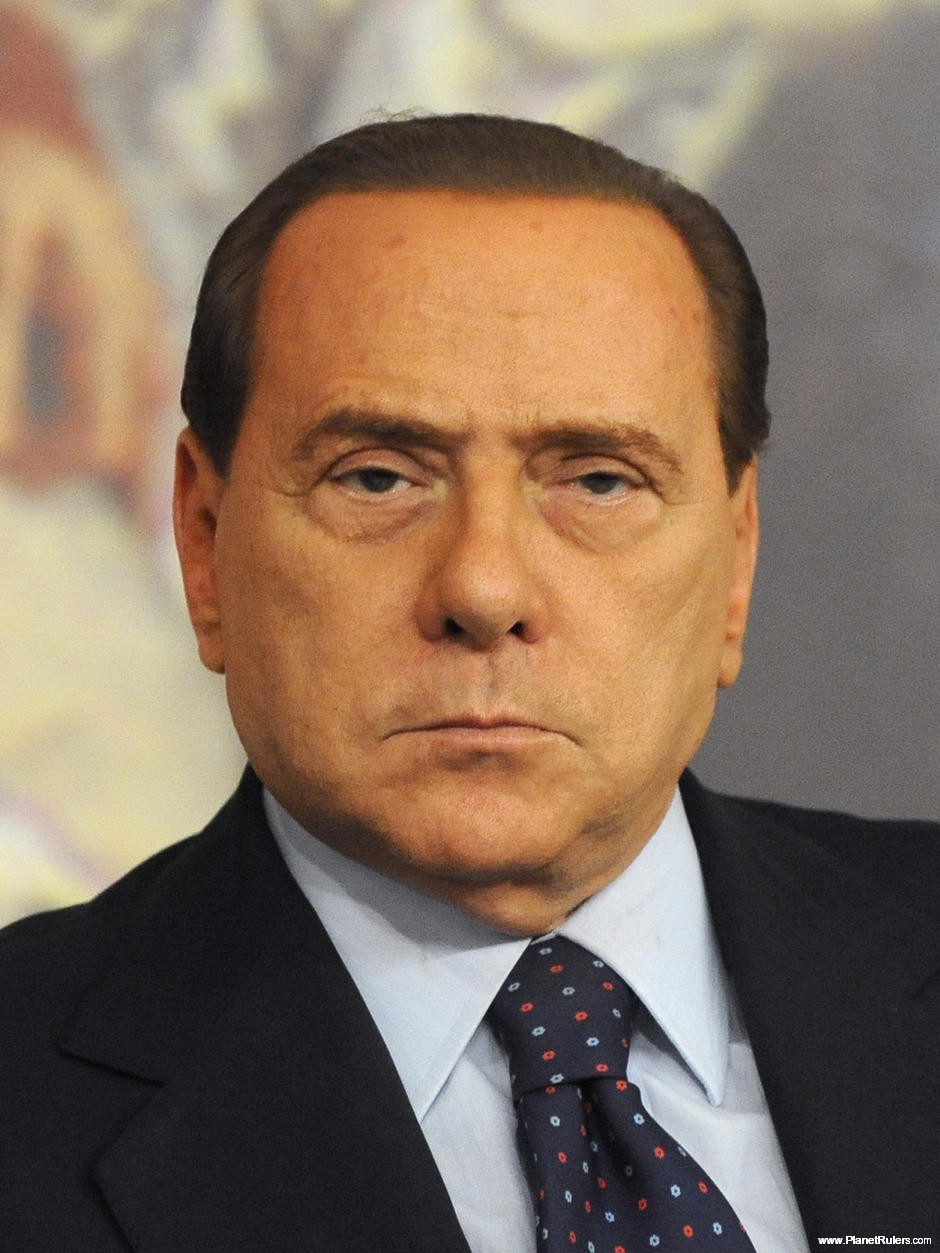
Silvio Berlusconi, Prime Minister of Italy
Born in Milan September 29, 1936. Married, five children. He lives in Milan.
Graduated in Law with honors. Entrepreneur.
Knight’s work. In 1962 he began working in the area of the building contractors. Be the first Italian player in the development of residential and commercial centers (Milan 2, Milan 3, Sunflower). In 1980 he founded Channel 5, the first national television network, in addition, Italy 1 (1982) and Rete 4 (1984). The commercial success of the TV allows you to develop various initiatives, insert, like all other companies within the parent holding company Fininvest, founded in 1978.
Spread so commercial television in Europe: France La Cinq (1986), Germany Telefünf (1987), Telecinco in Spain (1989). With the Mondadori (1989) becomes the main Italian publisher in books and periodicals. The Fininvest Group, with Mediolanum and Italy Program, to develop a strong presence in insurance and financial products. President since 1986 is the football team AC Milan which led to being the first club in the world for the number of international victories. On January 26, 1994 he resigned all his positions in Fininvest.
Foreign Languages
French and English.
POLITICAL PROFILE
Positions of party and political activity
Founder and President of the political movement Forza Italy. ”
Founder and President of the Political Movement “People of Freedom.”
Institutional charges and parliamentary activity
In the XII legislature was Prime Minister from May to December 1994. Later he was part of the 3rd Standing Committee – Foreign and Community Affairs. In 1994 he participated in elections to the European Parliament shall be elected in all five boroughs Italian, but has not joined the Assembly for incompatibility with the office of President of the Council then held. In the XIII legislature has been part of the 3rd Standing Committee – Foreign and Community Affairs, the 1st Standing Committee – Constitutional Affairs, the Council Presidency and interior of the parliamentary commission for constitutional reforms, the Italian Parliamentary Delegation to the Assembly of the Council ‘s Europe and the Italian parliamentary delegation to the Assembly of Western European Union. In 1999, reelected to Parliament, V term, resigned June 10, 2001 for incompatibility with the office of President of the Council of Ministers, who served in the XIV legislature of the National Parliament. Interim Minister for Foreign Affairs on 6 January 2002 to November 14, 2002, Interim Minister of Economy and Finance 3 to 16 July 2004 and interim Minister of Health 11 March 2006.
On November 18, 2007 in Piazza San Babila in Milan announces the birth of the future movement “People of Freedom” which is actually founded February 27, 2008.
With the same movement won the parliamentary elections of 13 and 14 April 2008.
In the sixteenth term becomes President of the Council of Ministers for the fourth time.
13-14 April 2008 elections
Elected to the House in the list The People of Freedom in the Molise Region XVIII with 71,994 votes equal to 36.48%.
Previous elections
Elected in the 1994 consultation, the College District No. 1 of the XV-Lazio 1, with 34,534 votes – 46.3%. Linked lists: Forza Italy, the National Alliance. Reelected in 1996 with the Pole for Freedom in College 1 – 1 Milan, Lombardy 1 of the Third District, with 46,135 votes – 51, 5%. Linked lists: Forza Italy.
Confirmed in 2001 with the House of Freedoms in the College # 1 – 1 Milan, the Lombardy Region III 1 with 42,086 votes – 53.7%. Linked lists: Forza Italy.
Reelected in 2006 in Italy in the nineteenth Force list Campania Region 1 with 492,594 votes equal to 27.23%. Linked lists: Forza Italy.
Assignments and activities in local authorities
City Councilman at the Commune of Milan from 27 April 1997 to May 12, 2001, from May 13 to November 9, 2001, from 28 May 2006 to 12 May 2008.
Giorgio Napolitano, President of Italy
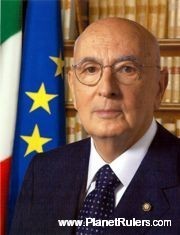
Giorgio Napolitano was born in Naples on June 29th, 1925.
He graduated in law from Naples University in December 1947, with a dissertation on political economy entitled Il mancato sviluppo industriale del Mezzogiorno dopo l’unità e la legge speciale per Napoli del 1904 (The Failure to Bring about Industrial Development in Southern Italy after Italy’s Unification and Special Legislation for Naples in 1904). In 1945-46 he engaged actively in the Student Faculty Councils movement, and was a delegate to the first National University Congress.
In 1942, as un undergraduate in Naples, he joined a group of young anti-Fascists and in 1945 he joined the Italian Communist Party, of which he was a militant and then a leading figure until the Democratic Party of the Left was established.
From the autumn of 1946 to the spring of 1948 he was a member of the Secretariat of the Italian Economic Centre for Southern Italy, chaired by Senator Paratore. He took also an active part for over 10 years in the Movement for the Rebirth of Southern Italy, since its foundation in December 1947.
He was elected to the Chamber of Deputies for the first time in 1953, and with the exception of the 4th Parliament he was a Member of Parliament until 1996, always re-elected in the Naples constituency.
His parliamentary activity began as a member of the Budget and State Holdings Committee, and focused – also in debates on the Floor of the House – on the issues of Southern Italy’s development and national economic policy.
In the 8th (from 1981) and 9th Parliaments (until 1986) he chaired the Communist group at the Chamber of Deputies.
During the 1980s his activity focused on international and European policy issues, both as a member of the Foreign Affairs Committee of the Chamber of Deputies and (from 1984 to 1992 and from 1994 to 1996) of the Italian delegation to the North Atlantic Assembly, and also through manifold political and cultural initiatives. As far back as the 1970s he was an active lecturer abroad, visiting International Policy Institutes in the UK and Germany and several US Universities (Harvard, Princeton, Yale, Chicago, Berkeley, SAIS and CSIS in Washington).
From 1989 to 1992 he was a Member of the European Parliament.
On June 3rd 1992, in the 11th Parliament, he was elected Speaker of the Chamber of Deputies, and remained in office until the end of that Parliament in April 1994.
During the 12th Parliament he was a member of the Foreign Affairs Committee, and Chairman of the Special Committee on the Reorganisation of Broadcasting Sector.
During the 13th Parliament he served as Minister of the Interior and for the Coordination of Civil Protection in the Prodi Government, from May 1996 to October 1998.
Since 1995 he has been the President of the Italian Council of the European Movement.
From June 1999 to June 2004 he chaired the Constitutional Affairs Committee of the European Parliament.
In the 14th Parliament the then Speaker of the Chamber of Deputies, Pier Ferdinando Casini, appointed him as Chairman of the Foundation of the Chamber of Deputies, an office which he held until the end of that Parliament.
On September 23rd 2005 he was appointed life senator by the President of the Republic, Carlo Azeglio Ciampi.
On May 10th 2006 he was elected President of the Republic with 543 votes. He was sworn-in on May 15th, 2006.
In acknowledgement of hid dedication to the cause of Parliamentary democracy and his contribution to the rapprochement between the Italian Left and European Socialism, in 1997 he was awarded the Leibnitz-Ring International Award in Hannover for his “lifelong” commitment.
In 2004 he was awarded an Honorary Doctorate in Political Science from Bari University.
He contributed in particular to the journal Società (Society) and, from 1954 to 1960, to the journal Cronache meridionali (Southern Chronicles), with essays on the Mezzogiorno (South of Italy) debate following the Liberation, on the thinking of Guido Dorso, on agricultural reform policies and on Manlio Rossi-Doria’s theses on the industrialisation of Southern Italy. In 1962 he published his first book Movimento operaio e industria di Stato (Workers’ Movement and State Industry), with special reference to the analysis of Pasquale Saraceno.
In 1975 he published the book Intervista sul PCI (The Italian Road to Socialism: An Interview by Eric Hobsbawm with Giorgio Napolitano of the Italian Communist Party), which was translated and published in over 10 countries.
In 1979 he wrote In mezzo al guado (At Mid-Crossing), about the period of the so-called “democratic solidarity” (from 1976 to 1979), when he acted as spokesperson for the PCI and handled relations with the Andreotti government on economic and trade union issues.
In 1988, in his book Oltre i vecchi confini (Beyond Old Boundaries), he addressed the problems that arose in the years of the thaw in relations between East and West, at the time of President Reagan in the USA and President Gorbachev in the USSR.
His work Al di là del guado: la scelta riformista (Beyond the Crossing: the Reformist Choice) collects his public addresses from 1986 to 1990.
The book Europa e America dopo l’89 (Europe and America after 1989), published in 1992, is a collection of lectures he gave in the United States after the fall of the Berlin wall and the Communist regimes in Central and Eastern Europe.
In 1994 he published, partly in the form of a personal diary, the book Dove va la Repubblica – Una transizione incompiuta (Where the Republic is Heading – An Unfinished Transition), on the period of the 11th Parliament, form his viewpoint as Speaker of the Chamber of Deputies.
In 2002, he published his book Europa politica (A Political Europe), at the height of his activity as Chairman of the Constitutional Affairs Committee of the European Parliament.
His latest book Dal PCI al socialismo europeo: un’autobiografia politica (From the PCI to European Socialism: a Political Autobiography) was published in 2005.